
ENLARGED PROSTATE TREATMENT IN BENGALURU
Frequent Urination? Weak Urine Flow?
It Could Be an Enlarged Prostate.
Are frequent bathroom visits, interrupted sleep, or difficulty passing urine affecting your daily life? Benign Prostatic Hyperplasia (BPH), commonly known as an enlarged prostate, can cause bothersome urinary symptoms. Consult Dr. Monish V, Vascular Surgeon and Interventional Radiologist, to understand your condition and explore suitable treatment options, including Prostatic Artery Embolization (PAE), when appropriate.
Personalized evaluation of urinary symptoms
Minimally invasive, image-guided treatment options
Potential alternative to prostate surgery for selected patients
Treatment recommendations tailored to your condition
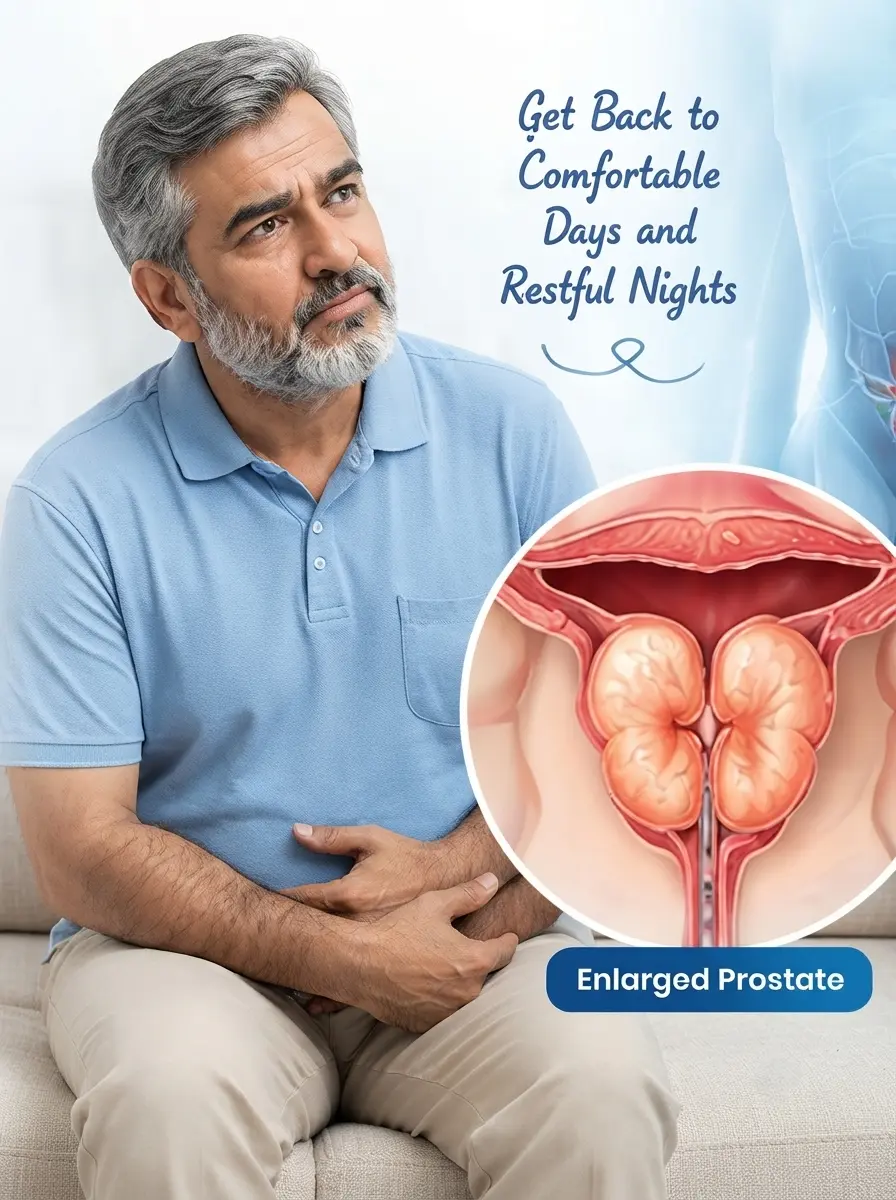
Is an Enlarged Prostate Affecting Your Daily Life?
Common symptoms of BPH
As men age, the prostate gland may gradually enlarge and press against the urethra, making it harder for urine to pass.
Frequent urination during the day
Multiple times at night to urinate
Weak or slow urine stream
Difficulty starting urination
Interrupted urine flow
Feeling that your bladder has not emptied completely
Urgency or a sudden need to urinate
Dribbling after urination

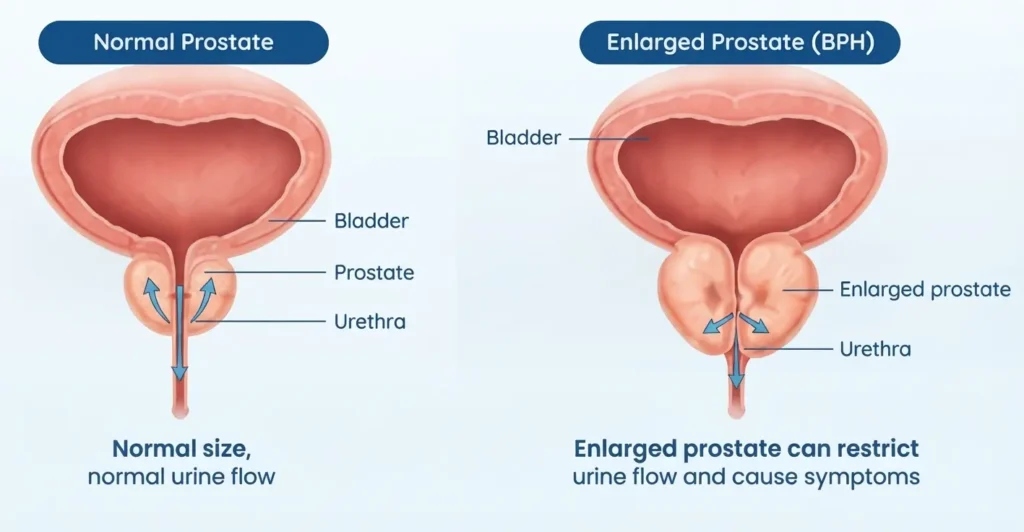
Understanding Benign Prostatic Hyperplasia (BPH)
The prostate is a gland located below the bladder and surrounding the upper part of the urethra, the tube that carries urine out of the body.
Benign Prostatic Hyperplasia (BPH) is a non-cancerous enlargement of the prostate. As the gland grows, it may restrict urine flow and cause bothersome urinary symptoms.
- BPH is not prostate cancer.
- Prostate enlargement does not always cause symptoms.
- Urinary symptoms can also result from other conditions.
- Early evaluation can help identify complications and suitable treatment options.
Treatment Options for an Enlarged Prostate
What Are Your Treatment Options for BPH?
The right treatment depends on your symptoms, prostate size, bladder function, medical history, and personal preferences.
Medication
Medications may help relax the muscles around the prostate or bladder neck, or gradually reduce prostate size. Your doctor will determine which medication is appropriate.
Prostatic Artery Embolization (PAE)
PAE is a minimally invasive, image-guided procedure performed by an Interventional Radiologist. Tiny particles are delivered through a catheter into selected arteries supplying the prostate, reducing its blood supply and helping it shrink over time.
TURP (Transurethral Resection of the Prostate)
TURP is an endoscopic procedure that removes prostate tissue to improve urine flow. It is an established treatment for men with bothersome BPH symptoms who need a procedure.
HoLEP (Holmium Laser Enucleation of the Prostate)
HoLEP uses laser energy to remove obstructing prostate tissue. It may be suitable for men with different prostate sizes, depending on their clinical assessment.
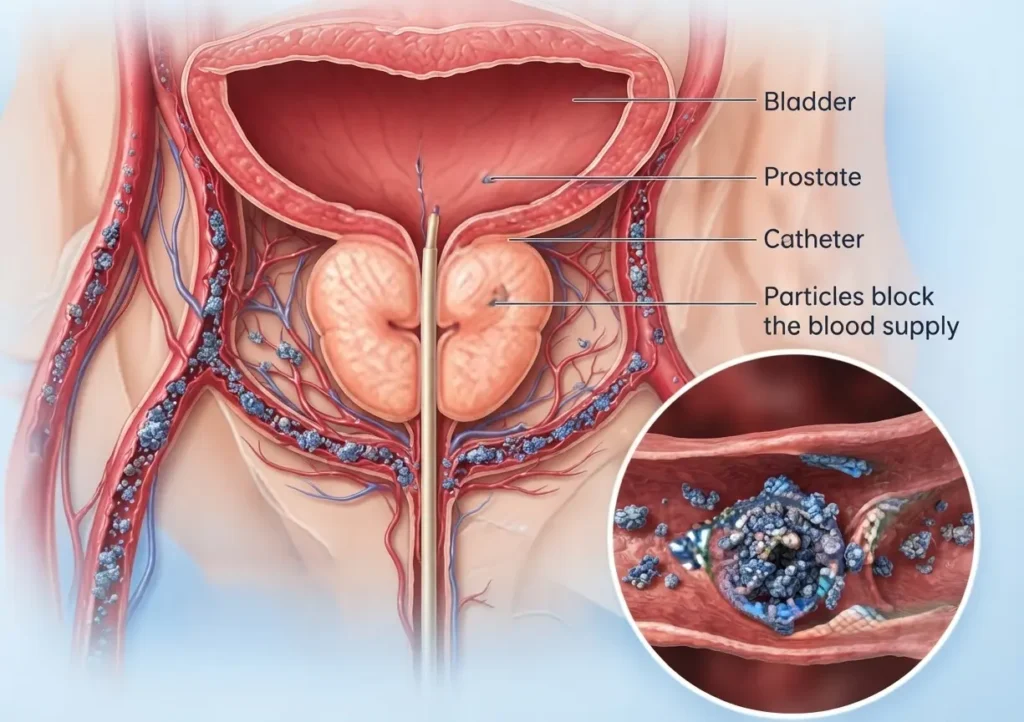
Prostatic Artery Embolization (PAE)
A Minimally Invasive Option for BPH
If an enlarged prostate is affecting your urinary function, Prostatic Artery Embolization may be an option worth discussing with an Interventional Radiologist. PAE is performed through a small catheter inserted into an artery, usually at the wrist or groin. Using imaging guidance, the doctor delivers tiny particles into selected arteries supplying the prostate. This reduces blood flow to the prostate, helping it shrink gradually and potentially improving urinary symptoms.
Potential Benefits for Suitable Patients
- No need for an incision through the prostate
- Minimally invasive, catheter-based approach
- May be performed under local anesthesia with appropriate sedation
- May offer a shorter hospital stay or recovery period than some surgical procedures
- Can be considered for selected patients seeking an alternative to surgery


Meet Dr. Monish V
An Vascular Interventional Radiologist at Yelahanka, Bengaluru
Dr. Monish V is a Vascular Specialist at Manipal Hospital Yelahanka and Venuva Vascular Centre, Malleshwaram, with over a decade of experience in minimally invasive, image-guided treatments. He helps patients avoid major surgery by offering non-surgical and catheter-based solutions wherever appropriate. Patients looking for information about Varicose Veins Treatment Cost in Bangalore can consult him to understand the available procedures and associated costs based on their condition.
His clinical focus includes conditions such as varicose veins, varicocele, uterine fibroids, thyroid nodules, enlarged prostate, blocked leg arteries, and selected cases of deep vein thrombosis. For patients seeking Affordable Fibroid Embolization Treatment in Bangalore, he provides guidance on suitable minimally invasive treatment options. Many procedures are performed as day-care treatments, offering faster recovery, minimal discomfort, and minimal scarring.
Dr. Monish has been published in reputed national and international journals and has presented his work at leading interventional radiology conferences. He is actively involved in advancing evidence-based, minimally invasive care.
- His philosophy is simple.
- Explain options clearly.
- Choose the safest effective treatment.
- Recommend surgery only when it is truly necessary.
What Patients Say

 Vasanth Sagar
Trustindex verifies that the original source of the review is Google.
Good response from the staff. Cafeteria needs to have more options Sandhya AnilAll the staffs were humble and friendly. Even service was good.
 SHARWAN VHealth checkup department yelahanka staffs are helpful and doing great service
 ravichandta raviManipal hospital Yelahanka i had health checkup today evening good and done well... service was good 👍 i recommend
 Ankur PrashantI visited Manipal hospital Yelahanka today and I met Dr Ashok Kumar from ortho and was assisted by Chaya and Tanushree and Sanika and the experience was really good. He explained the treatment very well and it was really informative
 Saibanna BiradarManipal hospital Yelahanka - I had very great experience, I had come for my petct scan the Dr Reddy, Madam Kavitha Ms Martina Sister Soundini treated me so well that I did not felt that I came for any scan family atmosphere they created.. Thank you to all Nuclear medicine team for the support ..
 Ramanatha RaoThis is V. Gayathri. I visited Manipal Hospital, Yelhanka, today. The building is very spacious and clean. I consulted the orthopedic, Dr. Sridhar Singh; he was very friendly and cooperative. I had to get two x-rays done, and the staff there were very good and courteous. The staff in the orthopedic wing was quite helpful and compassionate; I was deeply touched. Overall, the hospital visit was very good. Service at the cafeteria on the ground floor was nice, but it is too small for a hospital of that size. Though there is one on the 5th floor, the patients on the ground floor need a bigger cafeteria. Maybe another cafeteria can be opened on the ground floor. Thanks.
How Does PAE Work?
01. Consultation & Assessment : Your urinary symptoms, medical history, medications, and previous investigations are reviewed.
02. Diagnostic Evaluation : Tests may include urine analysis, prostate assessment, PSA when appropriate, and imaging to evaluate your condition.
03. Image-Guided Embolization : If PAE is appropriate, a catheter is guided into the arteries supplying the prostate and tiny embolic particles are delivered.
04. Recovery & Follow-Up : Follow-up appointments help assess symptom improvement, monitor recovery, and determine whether further treatment is needed.
Is It Time to Get Your Prostate Checked?
A consultation may be helpful if you:
- Frequently wake up at night to urinate.
- Experience a weak or interrupted urine stream.
- Find it difficult to start urinating.
- Feel that your bladder does not empty completely.
- Have urinary symptoms that interfere with work, sleep, or travel.
- Have been diagnosed with BPH and want to explore alternatives to surgery.
- Are already taking medication but continue to experience bothersome symptoms.
CONSULT IN PERSON
Two clinics across North & Central Bengaluru.
Manipal Hospital, Yelahanka — North Bengaluru
Vascular & Interventional Radiology OPD, Yelahanka, Bengaluru, Karnataka
Venuva Vascular Centre — Central Bengaluru
Dedicated vein & vascular clinic, Malleshwaram, Bengaluru, Karnataka
frequently asked questions
Is an enlarged prostate the same as prostate cancer?
No. Benign Prostatic Hyperplasia (BPH) is a non-cancerous enlargement of the prostate. However, BPH symptoms can overlap with those of other conditions, including prostate cancer, so appropriate evaluation is important.
Can an enlarged prostate be treated without surgery?
Yes. Depending on symptom severity and prostate characteristics, treatment may include lifestyle adjustments, medication, or Prostatic Artery Embolization (PAE). Some patients may benefit more from an endoscopic or surgical procedure.
What is Prostatic Artery Embolization (PAE)?
PAE is a minimally invasive, image-guided procedure in which tiny particles are delivered through a catheter into selected arteries supplying the prostate. This reduces blood flow to the prostate, helping it shrink over time and potentially improving urinary symptoms.
Is PAE an alternative to prostate surgery?
PAE can be an alternative to certain surgical treatments for appropriately selected patients. However, it may not provide the same degree of symptom relief or improvement in urine flow as some surgical procedures. A specialist can explain the benefits and limitations of each option.
Is Prostatic Artery Embolization painful?
The procedure is generally performed using local anesthesia, sometimes with sedation. Some patients experience discomfort during or after treatment. Your medical team will explain how pain and other side effects are managed.
How long does recovery take after PAE?
Recovery varies by patient. Many patients can return to routine activities relatively quickly, but urinary symptom improvement usually develops gradually over several weeks or months.
Can an enlarged prostate be treated with medication?
Yes. Several medications can help manage BPH symptoms. The choice depends on symptom severity, prostate characteristics, other medical conditions, and possible medication side effects.
Does every enlarged prostate need treatment?
No. Men with mild symptoms may only need monitoring and lifestyle adjustments. Treatment is considered when symptoms become bothersome or complications develop.
How is an enlarged prostate diagnosed?
Assessment may include a medical history, urinary symptom questionnaire, physical examination, urine testing, PSA testing when appropriate, measurement of urine flow, assessment of residual urine, and prostate imaging when indicated.