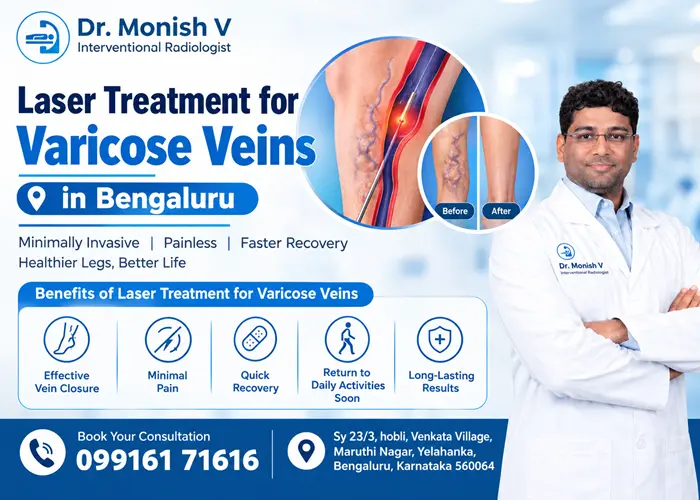
Laser Treatment for Varicose Veins in Bengaluru is a minimally invasive option for people experiencing enlarged, twisted, or painful veins in the legs. Varicose veins develop when valves inside the veins do not work properly, allowing blood to flow backward and collect in the affected vein. Over time, this can cause visible veins, heaviness, swelling, aching, and skin changes.
Modern vascular care focuses on accurate diagnosis and selecting treatment according to the severity, location, and underlying cause of the venous problem. Laser Treatment for Varicose Veins in Bengaluru may be considered when conservative measures are not sufficient and an abnormal superficial vein requires closure.
The treatment commonly uses endovenous laser treatment for varicose veins, in which a thin laser fibre is introduced into the affected vein under ultrasound guidance. Laser energy heats the vein wall, causing the vein to close. Blood is then redirected through healthier veins.
Symptoms, Causes & Diagnosis
Common Symptoms of Varicose Veins
People with varicose veins may experience:
- Enlarged, twisted veins visible beneath the skin
- Aching or throbbing in the legs
- Leg heaviness or tiredness
- Swelling around the ankles
- Burning or itching near affected veins
- Muscle cramps, particularly at night
- Skin discoloration
- In advanced cases, skin ulcers
Symptoms may become more noticeable after prolonged standing or sitting and may improve when the legs are elevated.
Causes and Risk Factors
Varicose veins are usually associated with weakened or damaged venous valves. Important risk factors include:
- Family history of varicose veins
- Increasing age
- Pregnancy
- Prolonged standing
- Obesity or excess weight
- Reduced physical activity
- Previous vein problems
- Conditions affecting venous circulation
Not every visible vein requires treatment. A vascular specialist should assess whether the veins are causing symptoms or are associated with underlying venous reflux.
Diagnosis
Diagnosis usually begins with a clinical examination and medical history. A duplex ultrasound is commonly used to evaluate blood flow, identify reflux, and determine which veins are responsible for the symptoms.
This assessment helps the specialist decide whether compression therapy, lifestyle measures, sclerotherapy, thermal ablation, or another intervention is appropriate.
Laser Treatment Procedure and Benefits
How Endovenous Laser Treatment Works
Laser Treatment for Varicose Veins in Bengaluru generally involves the following steps:
- The affected vein is identified using ultrasound.
- The skin is cleaned and local anaesthesia is administered.
- A small needle or catheter is introduced into the vein.
- A thin laser fibre is positioned inside the vein.
- Laser energy is delivered while the fibre is gradually withdrawn.
- Heat causes the treated vein to close.
- Blood naturally redirects through healthier veins.
The procedure is usually performed through a very small skin entry point rather than a large surgical incision.
Benefits of Laser Treatment
For appropriately selected patients, Laser Treatment for Varicose Veins in Bengaluru can offer several potential benefits:
- Minimally invasive approach
- Small access point
- Usually performed under local anaesthesia
- Less tissue disruption than traditional vein stripping
- Shorter recovery for many patients
- Reduced postoperative discomfort compared with conventional surgery in many cases
- Can effectively close the targeted refluxing vein
- Allows patients to return to routine activities relatively quickly
Treatment suitability depends on ultrasound findings, vein anatomy, symptoms, medical history, and individual expectations.
Recovery and Comparison With Other Treatments
Recovery After Treatment
Recovery following Laser Treatment for Varicose Veins in Bengaluru is generally quicker than recovery from traditional vein-stripping surgery, although individual experiences vary.
Patients are often encouraged to walk soon after the procedure. Mild bruising, tightness, tenderness, or discomfort along the treated vein can occur temporarily. Compression stockings may be recommended depending on the patient’s condition and the treating specialist’s protocol.
Patients should follow their doctor’s instructions regarding exercise, bathing, medication, compression, and follow-up appointments.
Laser Treatment vs Traditional Surgery
Traditional varicose vein surgery may involve ligation and stripping of the affected vein. Endovenous laser treatment uses a catheter and thermal energy to close the vein from inside.
Laser treatment may involve:
- Smaller access points
- Less invasive treatment
- Potentially faster recovery
- Less postoperative discomfort for many suitable patients
However, laser treatment is not automatically the best option for every patient. Some vein patterns may be better managed with other techniques.
Laser Treatment vs Sclerotherapy
Sclerotherapy uses an injected medicine to close selected veins and is commonly used for smaller varicose or spider veins. Laser ablation is more commonly considered for larger refluxing veins that are suitable for catheter-based treatment.
A vascular evaluation and duplex ultrasound help determine the appropriate approach.
Dr. Monish V and Vascular Services
Dr. Monish V provides evaluation and personalized management for patients with vascular conditions. His services may include assessment of varicose veins, vascular examination, duplex ultrasound-based treatment planning, and minimally invasive vascular procedures when clinically appropriate.
The treatment plan is based on the patient’s symptoms, ultrasound findings, vein anatomy, and overall health rather than on the appearance of veins alone.
Frequently Asked Questions
1. Is laser treatment for varicose veins safe?
Laser treatment is generally considered safe for appropriately selected patients when performed by an experienced vascular specialist. Temporary bruising, tenderness, inflammation, or skin irritation can occur. Less common complications include nerve irritation, infection, thrombosis, or recurrence.
2. How does laser treatment work for varicose veins?
During Laser Treatment for Varicose Veins in Bengaluru, a thin laser fibre is inserted into the affected vein under ultrasound guidance. Laser energy heats the vein wall and causes the abnormal vein to close.
3. How effective is laser treatment for varicose veins?
Endovenous laser treatment can be highly effective for closing appropriately selected refluxing veins. Long-term outcomes depend on vein anatomy, underlying venous disease, and follow-up care.
4. Is laser treatment painful?
The procedure is generally performed using local anaesthesia. Patients may feel pressure or mild sensations during treatment. Temporary soreness or tightness can occur afterward.
5. How much is laser treatment for varicose veins?
The laser treatment cost for varicose veins varies depending on the number and size of veins, diagnostic investigations, treatment technique, facility charges, and individual clinical requirements. A consultation and ultrasound assessment are needed for an accurate estimate.
6. Is laser treatment for varicose veins covered by insurance?
Insurance coverage varies according to the policy, insurer, documentation, and whether the procedure meets the insurer’s criteria for medical necessity. Patients should confirm coverage directly with their insurance provider.
7. How quickly can I return to normal activities?
Many patients can resume light daily activities relatively soon after treatment. The exact recovery period depends on the procedure and individual health. Strenuous exercise may need to be restricted temporarily according to medical advice.
8. Can varicose veins come back after laser treatment?
The treated vein is closed, but new varicose veins or reflux in other veins can develop over time. Regular follow-up and management of underlying venous disease can help with long-term care.
9. Do all varicose veins require laser treatment?
No. Treatment depends on symptoms, venous reflux, vein anatomy, severity, and overall clinical assessment. Some patients may benefit from lifestyle changes, compression therapy, sclerotherapy, or other treatments instead.
10. When should I see a vascular specialist?
Consult a vascular specialist if varicose veins are painful, increasingly swollen, associated with skin changes, bleeding, ulcers, or persistent leg heaviness. Early evaluation can help identify underlying venous reflux and appropriate treatment options.
Conclusion
Laser Treatment for Varicose Veins in Bengaluru provides a minimally invasive approach for selected patients with symptomatic varicose veins and venous reflux. Endovenous laser treatment for varicose veins uses ultrasound guidance and laser energy to close the problematic vein while allowing blood to flow through healthier veins.
The right treatment should always be determined after clinical evaluation and duplex ultrasound rather than based only on visible veins. Individual factors such as symptoms, vein anatomy, medical history, and treatment goals are important when planning care.
Book an Appointment With Dr. Monish V
If you are experiencing painful, swollen, or prominent varicose veins, consult Dr. Monish V for expert vascular evaluation and personalized treatment planning in Bengaluru. Discuss whether laser ablation or another minimally invasive treatment is appropriate for your condition.
Book an appointment with Dr. Monish V to discuss personalized varicose vein treatment options and take the next step toward better vascular health.